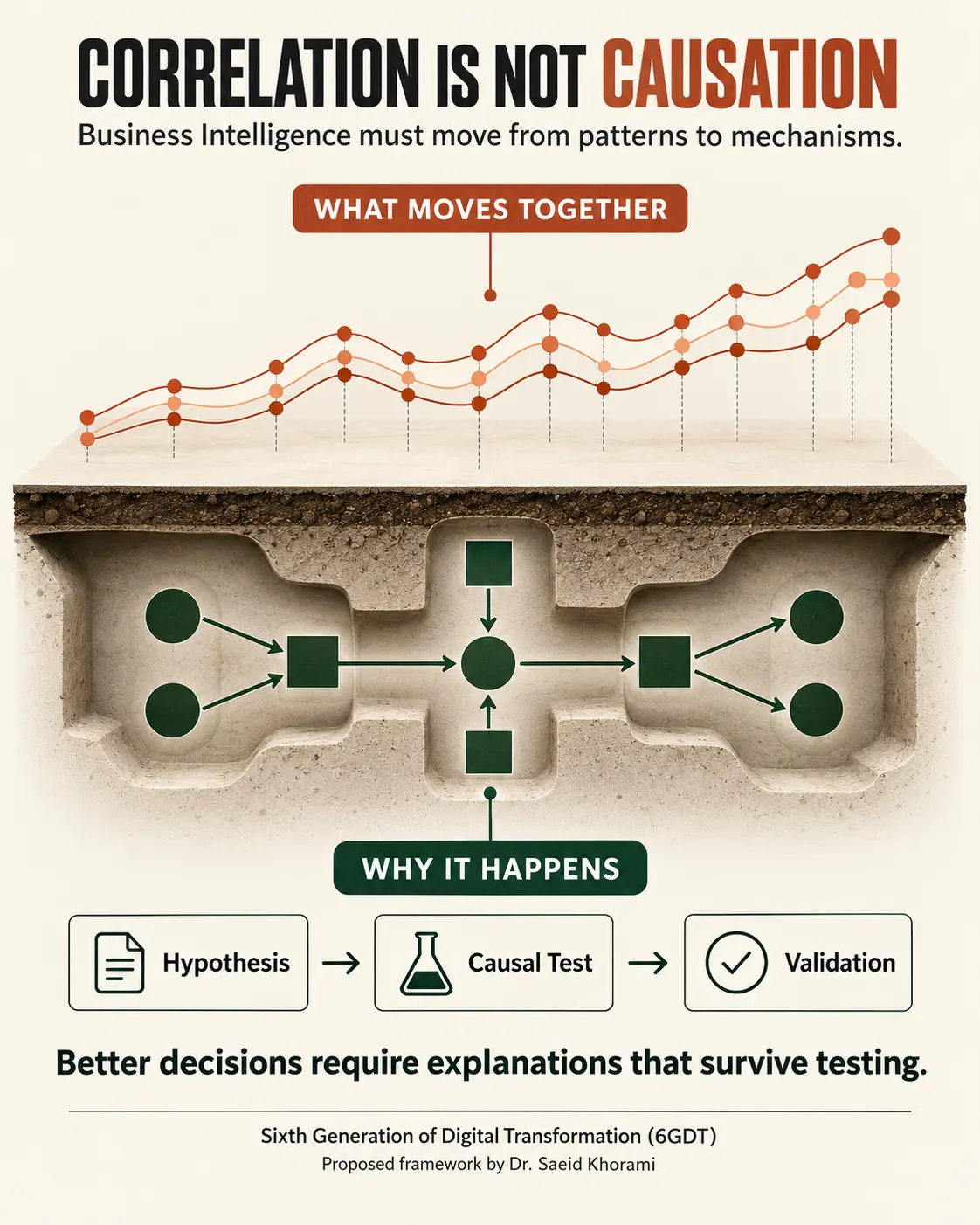
A pattern can be statistically strong and managerially misleading.
Business Intelligence is highly capable of identifying relationships within data. It can show that sales rose after a campaign, productivity changed after a system was introduced, or employee turnover moved alongside engagement scores. But movement together does not, by itself, explain why an outcome occurred.
The analytical problem
Correlation describes an observed relationship. Causal reasoning asks whether changing one factor would actually change another, through what mechanism, and under which conditions.
This distinction matters because managers do not merely observe systems; they intervene in them. When correlation is treated as causation, an accurate dashboard can still support the wrong action.
Interpretation through the proposed 6GDT framework
Within my proposed Sixth Generation of Digital Transformation (6GDT) framework, Inferential Intelligence extends the role of BI beyond description, prediction and generation.
The objective is to formulate hypotheses, expose hidden relationships, compare rival explanations, examine causal structures and submit conclusions to systematic validation. This is where Human-AI Co-Discovery becomes essential: AI can widen the field of possible explanations, while human judgment remains responsible for context, challenge, ethics and consequences.
A practical managerial sequence
- Hypothesis: state the proposed mechanism and the conditions under which it should hold.
- Causal test: examine competing explanations, hidden variables and evidence that could disconfirm the hypothesis.
- Validation: triangulate data, domain expertise and observed outcomes before authorising consequential action.
The purpose is not to turn every management decision into a laboratory experiment. It is to prevent confidence in a visible pattern from replacing disciplined explanation.
Boundary and limitation
This transition does not create automated certainty. Causal reasoning remains vulnerable to confounding, incomplete evidence, measurement error and biased assumptions. Inferential Intelligence should therefore be understood as a governed Human–AI capability, not as an autonomous truth engine.
Neo-Inference Science (NIS), proposed as a theoretical foundation for this research path, remains a developing conceptual framework requiring independent theoretical and empirical validation.
This page presents a conceptual interpretation and managerial research direction. It does not report an empirically tested causal model.
Question for managers
Where in your organisation might a strong correlation still be treated as a causal explanation?