The question is no longer whether artificial intelligence will enter politics. The question is whether politics can understand it quickly enough.
The Economist’s visual premise
In a recent item titled “The debate over AI has taken over Washington”, The Economist used a striking visual metaphor: the US Capitol moving slowly while AI accelerates around it.
This page does not reproduce The Economist’s artwork. The original site visual is an independent design, and the source is credited below.
Interpretation
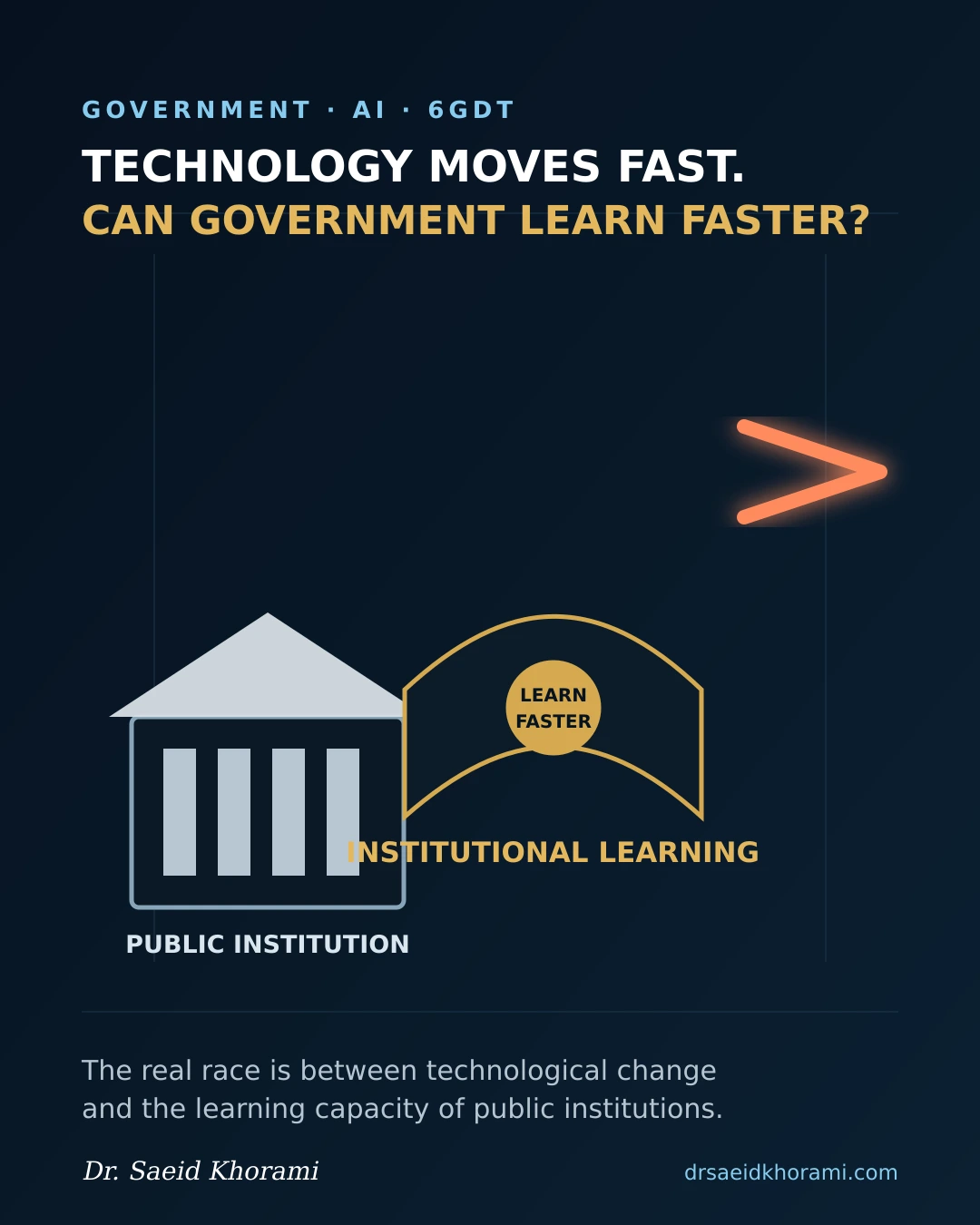
The image points to a problem that extends beyond Washington: the widening gap between technological speed and governmental decision-making. AI capabilities can change within months, while legislation, procurement, policy and institutional reform often move through much longer cycles.
Yet regulatory acceleration alone is not a sufficient response. A fast decision without understanding may be as dangerous as a delayed one. The managerial challenge is to increase the learning capacity of the institution—not merely the volume or speed of its rules.
Proposed 6GDT perspective
Within my proposed Sixth Generation of Digital Transformation (6GDT) framework, a government moves beyond consuming AI when it develops Inferential Intelligence: the joint human–AI capacity to formulate hypotheses, examine relationships, test counter-evidence and validate conclusions before they become public decisions.
This requires institutional memory, traceable evidence, human accountability and continuous learning. It does not mean allowing AI to make political decisions independently.
Management implication
Government capability should therefore be assessed not only by the number of AI systems deployed or regulations passed. It should also be judged by how quickly an institution can detect change, revise assumptions, test policy effects and carry validated learning into its next decision.
Foresight proposition
If public institutions cannot shorten their learning cycle, even well-designed laws may address a technological problem that has already changed before implementation. This is a forward-looking and testable proposition, not an established empirical conclusion.
Neo-Inference Science (NIS) is proposed as a theoretical foundation for this 6GDT perspective and remains open to independent conceptual and empirical validation.
Source and attribution
The Economist — “The debate over AI has taken over Washington”
The Economist is the source of the referenced headline and initial visual premise. The analysis, 6GDT interpretation and original site artwork on this page are independent.