Discovery and analysis
Reveal patterns, formulate alternatives and test scenarios.
Who owns a decision when AI recommends, a human validates, and the outcome causes harm?
Proposed concept · under development within 6GDT and NISAs Business Intelligence and AI-supported decision systems gain influence, accountability can disappear between the data source, the system, the analyst and the manager. A recommendation is produced, validated and approved; when the result is damaging, responsibility moves from one link to another.
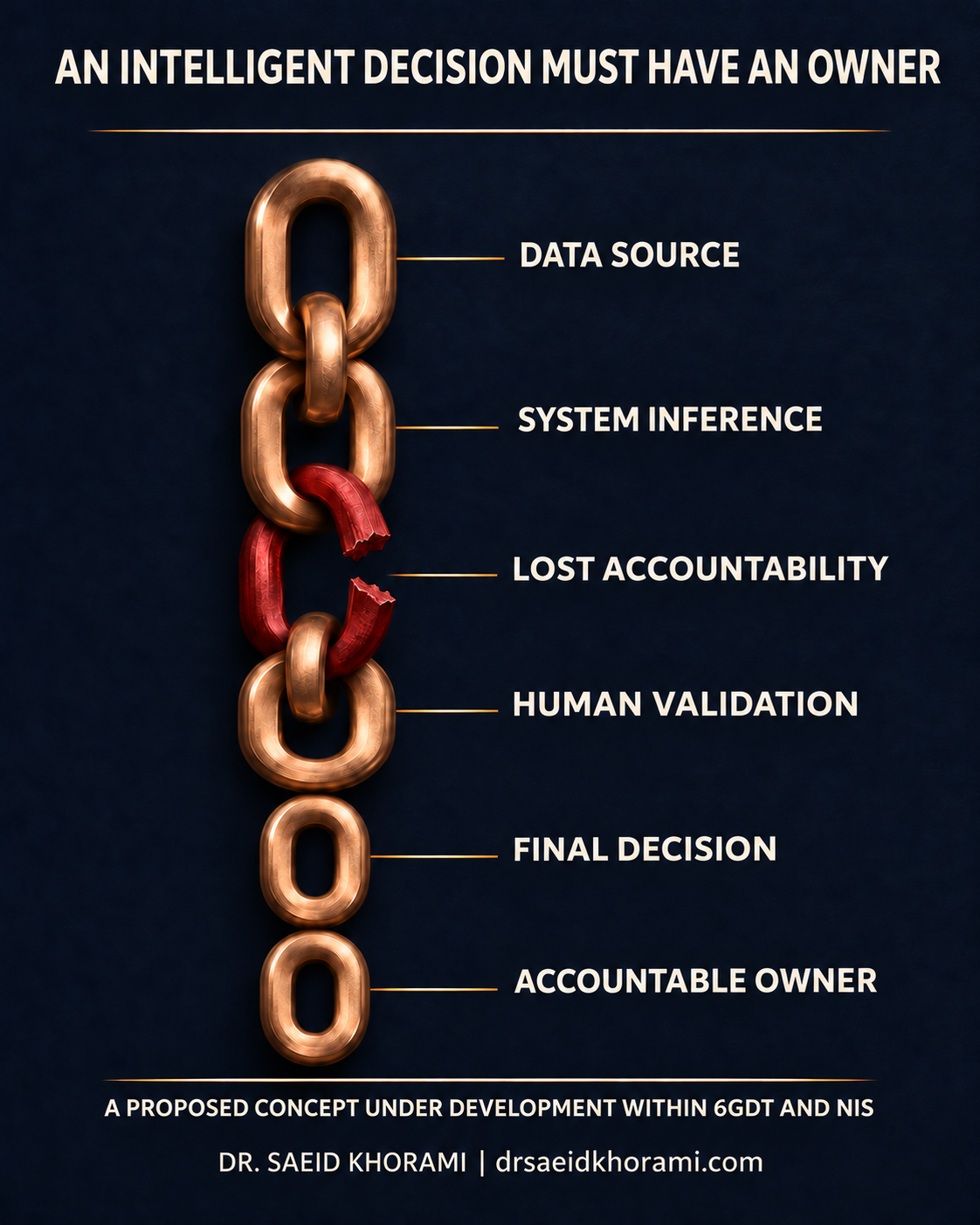
Technical transparency is not enough. Managers need a traceable chain that connects evidence, inference, validation, authority and consequences.
Within Dr. Saeid Khorami’s proposed and evolving Sixth Generation of Digital Transformation (6GDT) framework, Inferential Intelligence extends beyond prediction and generation toward hypotheses, relationships, causal questions and validated knowledge. This direction does not remove managerial responsibility; it makes the conditions of responsible judgment more explicit.
Inferential accountability is the traceable connection between data provenance, the inference pathway, human validation, decision authority and responsibility for consequences.
AI may identify hidden relationships, compare scenarios and reveal evidence that managers could overlook. It cannot, however, assume moral, legal or managerial accountability. Human judgment remains essential when a decision affects employees, customers, institutions or society.
Reveal patterns, formulate alternatives and test scenarios.
Interpret context, evaluate consequences and protect organizational values.
Define authority, escalation, review and corrective responsibility before deployment.
Neo-Inference Science (NIS) is proposed as a developing theoretical foundation for studying inference, Human–AI Co-Discovery and recursive knowledge evolution. Within this research direction, inferential accountability may provide a bridge between technical traceability and managerial responsibility.
This proposition remains conceptual. It requires measurable indicators, governance mechanisms, comparative studies and empirical testing before it can be treated as a validated model.