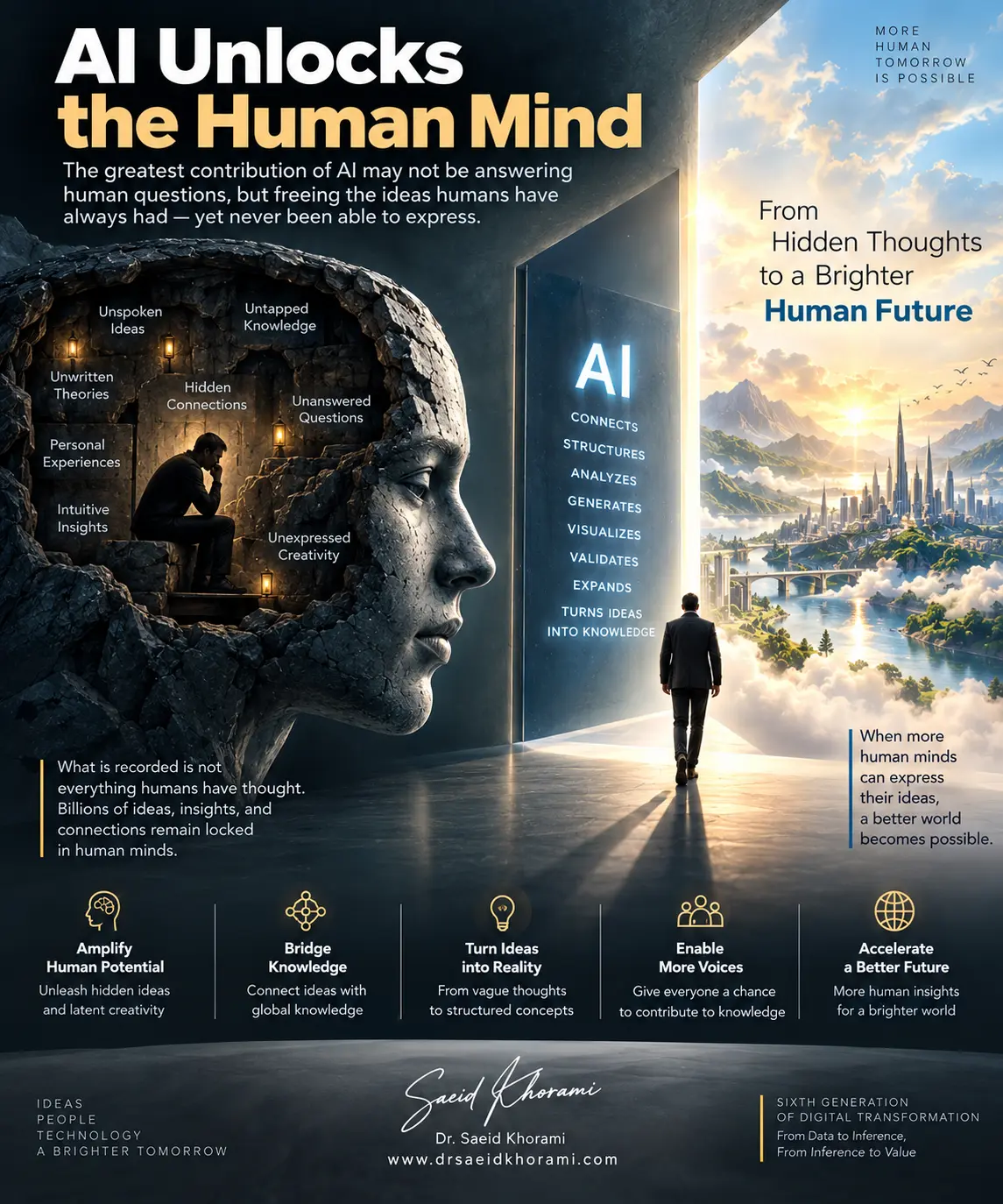
Perhaps the greatest impact of artificial intelligence on humanity will not be its ability to answer questions, but its ability to liberate thoughts that humans have always carried but were never able to express clearly.
Throughout history, a significant part of human intellectual capacity has never become knowledge.
Countless ideas, intuitions, experiences, connections, and questions may have remained trapped inside individual minds—not because they lacked value, but because their owners lacked the language, structure, visualization, scientific foundation, or analytical framework needed to communicate them.
Artificial intelligence may fundamentally change this.
For the first time, the distance between what a person can think and what that person can transform into communicable knowledge can be dramatically reduced.
A human being may begin with nothing more than a vague idea, an incomplete question, an intuition, or an unexplained connection between several phenomena. AI can connect that fragment to a vast body of existing knowledge, help find the right vocabulary, structure the reasoning, reveal possible relationships, generate hypotheses, test inconsistencies, and turn an unformed thought into something that can be examined, criticized, developed, and shared.
At that point, AI is no longer simply a tool for generating content.
It becomes an infrastructure for releasing humanity’s latent cognitive and inferential capacity.
If this hypothesis proves meaningful, then the consequences of AI extend far beyond productivity, automation, or speed.
We may be approaching the release of an intellectual reservoir that has remained largely inaccessible throughout human history.
Millions—and eventually billions—of people who might never have been able to write, theorize, model, design, or scientifically structure their ideas may now be able to contribute parts of their inner intellectual world to shared human knowledge.
In such a future, AI does not necessarily replace human thought.
And if billions of human minds can begin contributing even a fraction of their previously inaccessible intellectual potential, the pace of human development over the coming decades may become difficult to compare with anything in our historical experience.
The future of AI may ultimately be less about making machines more intelligent—and more about making human intelligence more expressible, accessible, and consequential.
Connection to the Sixth Generation of Digital Transformation
This concept is part of my broader research path on the Sixth Generation of Digital Transformation, where transformation moves beyond digitizing processes toward expanding human inference, meaning creation, and cognitive capability.
From Data to Inference. From Inference to Value.
This is a proposed hypothesis under development, presented for inquiry, critique, and future empirical examination.