Management Research Question | No. 06
Can the Transparency of a Process Help Hide the Real Decision?
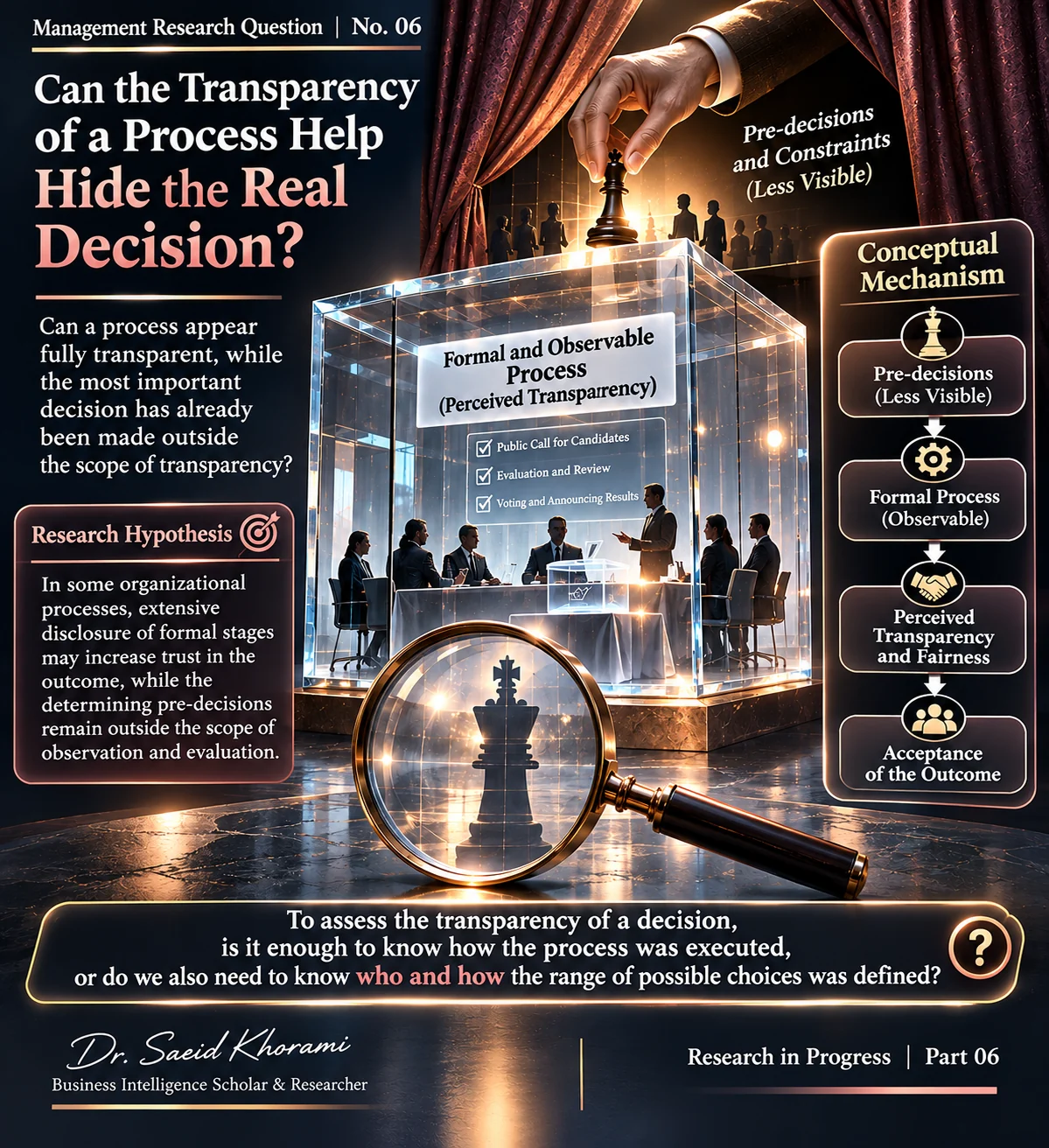
Transparency of procedures is not necessarily transparency of decision architecture.
Transparency is central to organizational governance. Yet a process can disclose its visible stages while leaving the earlier decisions that shaped the range of possible choices outside scrutiny.
The distinction
Consider an organization selecting a new leader. The call for candidates is public, evaluation criteria are documented, votes are counted accurately, and the result is announced. Nevertheless, the decision about who could enter the process may have been made earlier, under less visible conditions.
A conceptual mechanism
Less visible pre-decisions → Observable formal process → Perceived transparency and fairness → Acceptance of the outcome
Research proposition
In some organizational processes, extensive disclosure of formal procedures may increase confidence in the outcome while the determining pre-decisions remain outside the scope of observation and evaluation.
Research boundaries
This is a proposition for empirical investigation, not a demonstrated finding. It invites comparison with research on organizational legitimacy, selective transparency, institutional decoupling, and the architecture of decision-making.
The central question
To assess the transparency of a decision, is it enough to know how the process was conducted, or must we also understand who defined the available choices—and how?