How much was done?
Speed, volume, cost and completion: useful but incomplete measures.
Why can an AI system improve every operational metric while creating less public value?
Proposed conceptual analysis · requires empirical testingGovernments often evaluate AI through processing speed, lower cost, case completion and technical accuracy. These measures matter, but they do not establish that a public service has become fairer, more trustworthy or more effective.
The OECD Digital Government Outlook 2026 reports that AI is used in at least one area of government in 35 of 36 surveyed OECD countries, while only 10 report any financial or non-financial impact measurement of government AI use cases. UK government guidance likewise argues that evaluation must extend beyond technical benchmarks to intended and unintended outcomes, differences across groups, and a credible baseline or counterfactual.
Speed, volume, cost and completion: useful but incomplete measures.
Service quality, access, distribution of benefits and unintended effects.
Equity, rights, trust and fulfilment of the public mission.
Generative AI can draft reports, targets and policy options. Within Dr. Saeid Khorami’s proposed Sixth Generation of Digital Transformation framework, Inferential Intelligence is the joint Human–AI capacity to formulate hypotheses, examine causal relationships, seek disconfirming evidence and validate conclusions. It is not an automatic property of a model; it is an institutional capability.
For example, shorter processing time becomes evidence of success only when the institution can show what mechanism produced it, how different groups were affected and whether the core service mission was preserved.
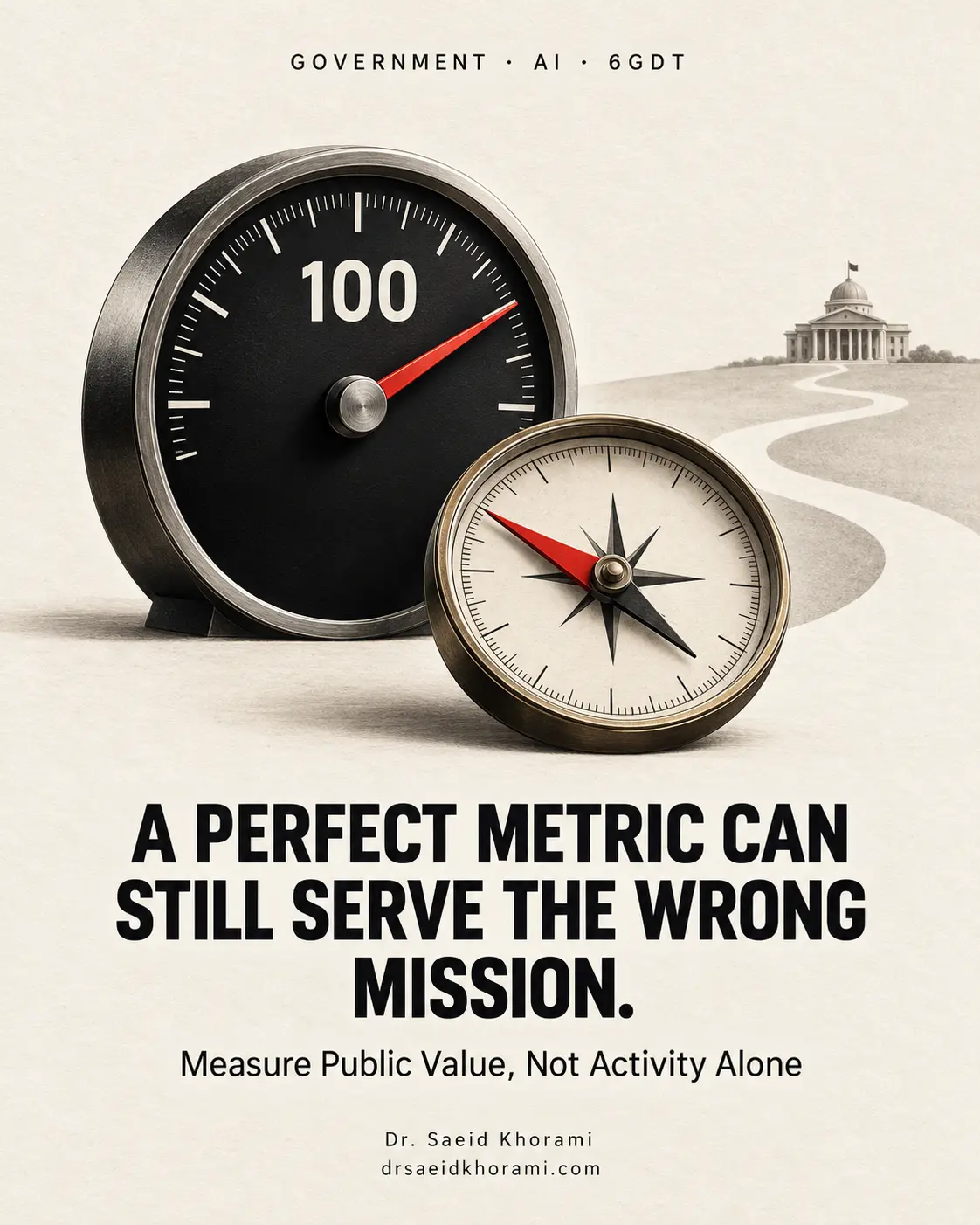
The Metric–Mission Gap is the distance between improvement in a system’s visible performance measures and the actual fulfilment of organizational mission or public value.
Interpretation: The principal problem is not always a lack of data. An organization may measure with great precision what has the weakest connection to its true mission.
Testable proposition: Organizations that connect operational metrics to distributional outcomes, rights and public value may detect mission drift earlier and correct AI-supported decisions faster.
Neo-Inference Science, proposed as a theoretical foundation for this direction, remains a developing research program. Independent studies are needed to test its causal mechanisms and empirical validity.