PROPOSED RESEARCH FRAMEWORK · BUSINESS INTELLIGENCE

The Seesaw Effect

A three-stage inquiry into whether extreme global intelligence asymmetry can move from competitive advantage to systemic fragility—and eventually rebound on the economies that initially benefit from it.

Conceptual framework · Testable hypothesis · Not a proven economic law
Core proposition. In an interconnected global system, intelligence advantage may increase value for leading economies only up to a critical threshold. Beyond that point, continued deterioration in the capacity of other participants may weaken the system on which the leaders themselves depend.
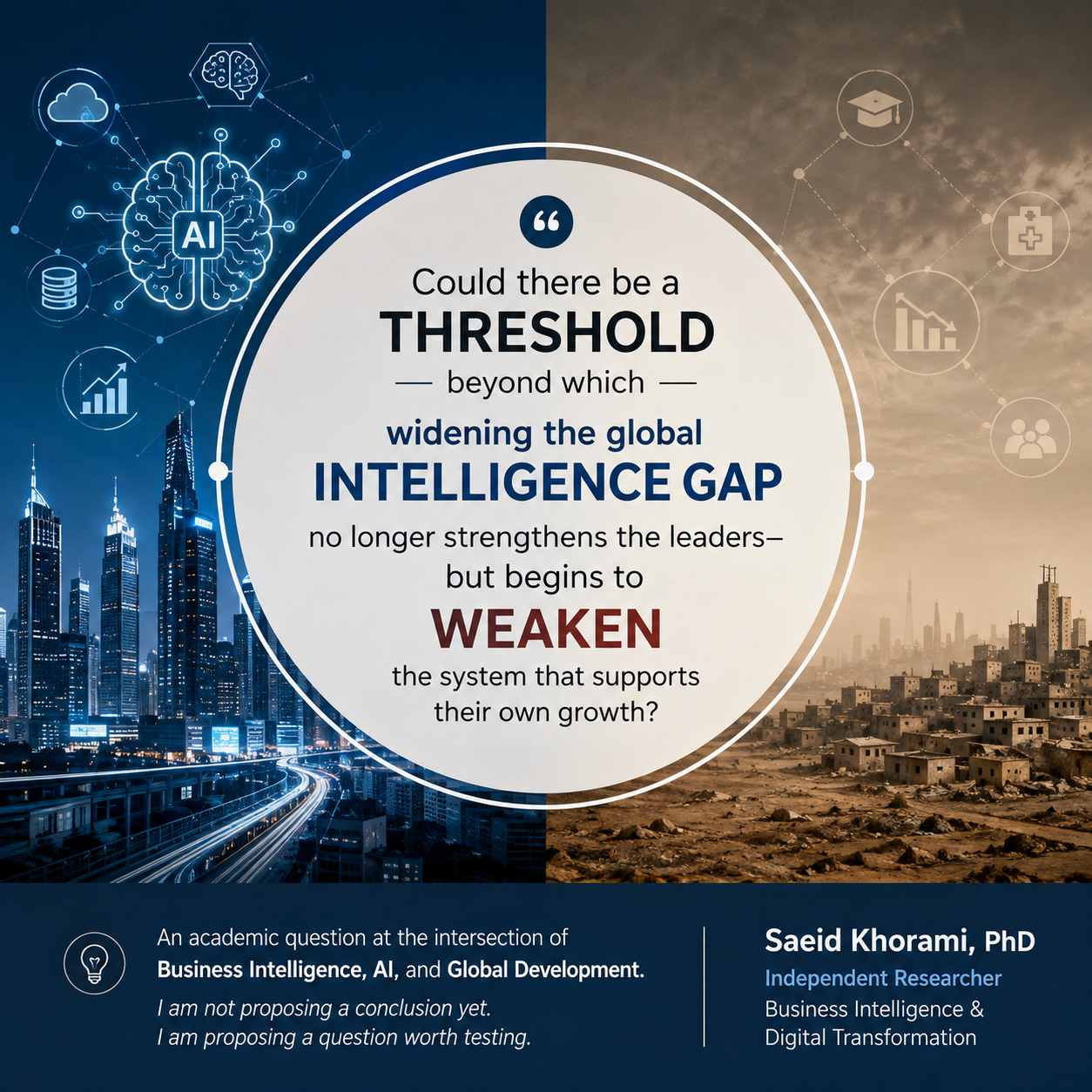
Stage I infographic: academic question about the global intelligence gap
STAGE I · THE QUESTION

Can an intelligence advantage become a vulnerability?

The inquiry begins with a question, not a conclusion. AI, Business Intelligence, data infrastructure and advanced decision capacity are unevenly distributed. The issue is whether a widening gap can eventually damage the very system that supports the growth of the leaders.

Could there be a point beyond which widening the global intelligence gap no longer strengthens the leaders, but begins to weaken the system that supports their own growth?
Stage II infographic: systemic intelligence imbalance and 6GDT
STAGE II · THE MECHANISM

When intelligence asymmetry becomes systemic

The gap is not only technological. It can become a gap in the ability to understand, anticipate, decide, discover and create value. The weaker side is not merely a competitor; it is also part of markets, demand, supply chains, human capital and the global value-creation system.

Proposed path: Intelligence Concentration → Systemic Imbalance → Rebound Effect.

6GDT connection

Within the proposed Sixth Generation of Digital Transformation, the focus moves beyond Generative Intelligence toward Inferential Intelligence. The future divide may therefore be between systems that can infer, discover relationships and create knowledge—and systems that remain primarily consumers of that intelligence. This is a conceptual extension of 6GDT, not an established empirical result.

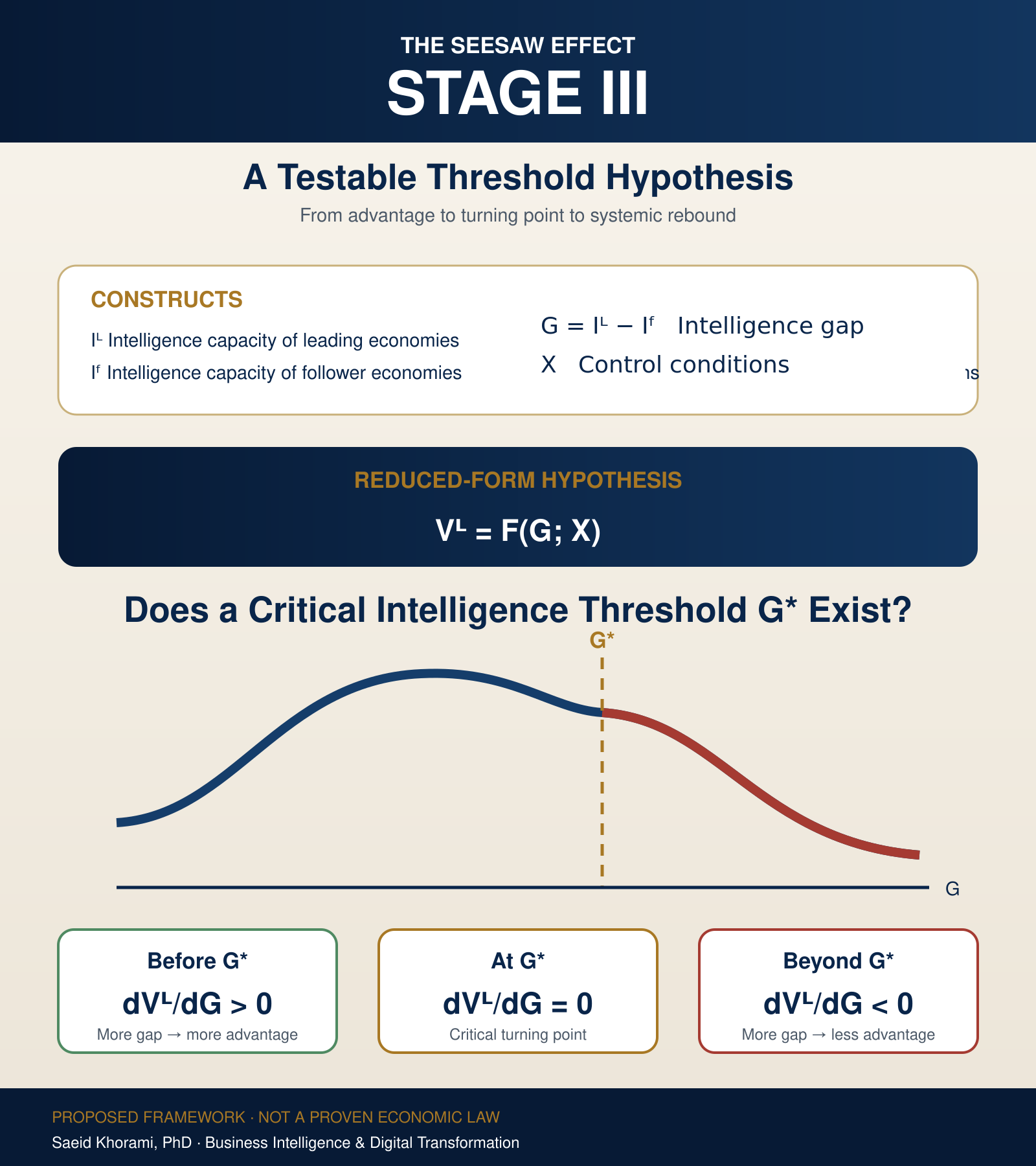
Stage III infographic: testable model of the Seesaw Effect
STAGE III · THE TESTABLE HYPOTHESIS

Does a Critical Intelligence Threshold exist?

Let Iᴸ represent the intelligence capacity of leading economies and Iᶠ the capacity of follower economies, measured on a comparable scale. Define the gap as G = Iᴸ − Iᶠ. Let Vᴸ represent the long-term value captured by leaders and X the relevant economic, institutional and geopolitical conditions.

Reduced-form hypothesis: Vᴸ = F(G; X)

Before G*dVᴸ/dG > 0More gap → more advantage
At G*dVᴸ/dG = 0Critical turning point
Beyond G*dVᴸ/dG < 0More gap → less advantage
The empirical challenge is simple to state and difficult to answer: Does G* exist?
RESEARCH STATUS

From metaphor to research program

The Seesaw Effect is presented here as a proposed conceptual framework from the perspective of Business Intelligence and digital transformation. It does not assume that global wealth is fixed, and it does not establish an economic law. The proposed mechanism is that, beyond a threshold, weaker demand, participation, absorptive capacity, innovation diffusion or supply-chain resilience may offset the leaders’ direct gains from a larger intelligence advantage.

What must be tested

Operationalize intelligence capacity, estimate the shape and timing of the relationship, and test whether a reproducible turning point G* appears in international panel data.

What could falsify it

The hypothesis would be weakened if the relationship remains positive after credible controls, if no stable turning point appears, or if observed reversals are better explained by income, institutions, education, conflict, trade or infrastructure.

Saeid Khorami, PhD
Independent Researcher · Business Intelligence & Digital Transformation