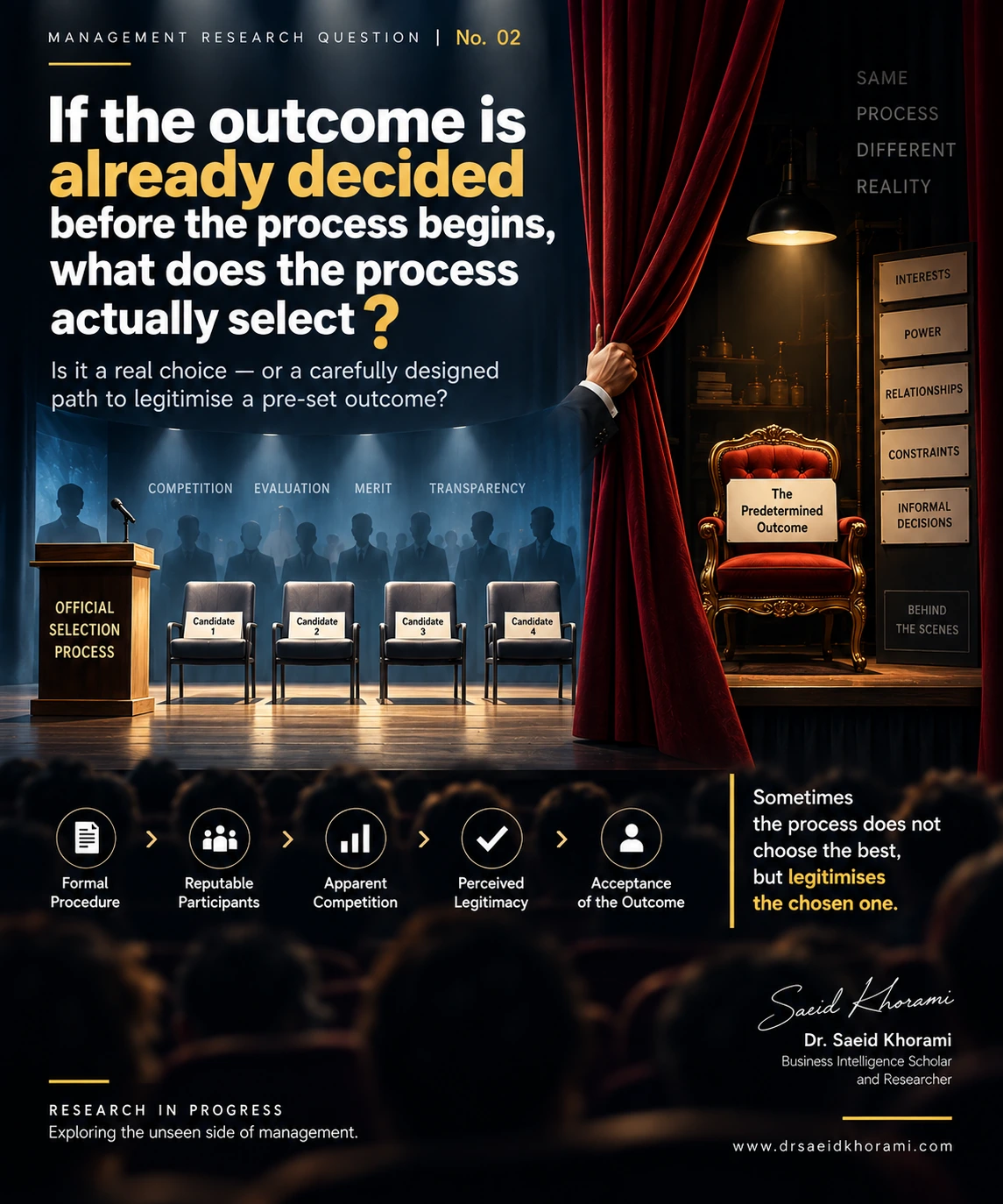
On the surface, everything may appear normal: a formal procedure is announced, several candidates participate, credible individuals enter the competition, evaluations are conducted, and eventually one candidate is selected.
But if the preferred outcome has already taken shape before the formal process begins, we need to ask a different question:
Under such conditions, a process designed to select may gradually become a process designed to legitimize.
The participation of credible candidates becomes particularly important. Their reputation can lend credibility to the process itself. Their presence signals genuine competition. Multiple candidates create the appearance of choice. Formal procedures reinforce the perception of fairness. Eventually, the legitimacy generated by the process can be transferred to its final outcome.
The question therefore becomes deeper:
This argument should not be interpreted as suggesting that every formal selection process is predetermined, nor does it question the merit of individuals participating in such processes. The object of this research is not the individuals. It is the management mechanism through which formal procedures, credible participants, and apparent competition may—under particular conditions—be transformed into resources for legitimizing a pre-existing preference.
This is where the inquiry moves toward organizational legitimacy, institutional decoupling, impression management, and organizational decision-making—and toward identifying what these established theories explain and what they leave unexplained.