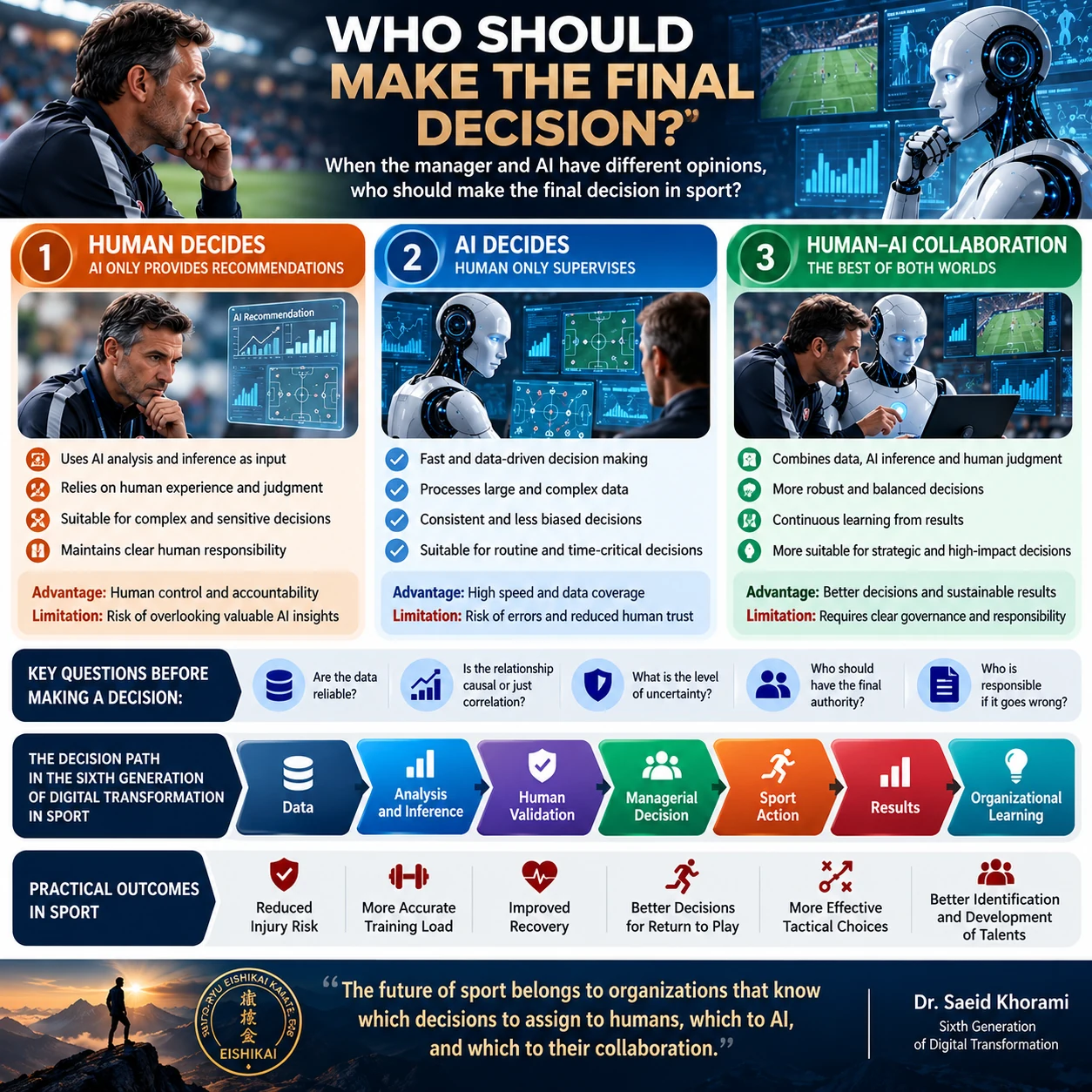
AI in sport is no longer only an analytical tool. It is increasingly entering the decision process.
The central question is no longer whether AI can produce an insight. It is whether that insight should remain advisory, become an automated decision, or be combined with human judgment.
Three decision architectures
AI analysis and inference inform the decision, while final authority and accountability remain clearly human.
Suitable only where the task is sufficiently structured, repeatable, measurable and low-risk, with clear override and audit mechanisms.
AI contributes scale, pattern detection and inference; humans contribute context, professional judgment, values and responsibility.
What must be checked before action?
- Are the underlying data reliable and sufficiently complete?
- Is the proposed relationship causal, or only correlated?
- What is the level of uncertainty?
- Can the result be transferred to this athlete, team or context?
- What is the cost of a wrong decision?
- Who has final authority—and who is accountable?
A Sixth-Generation decision path
The purpose is not to remove human decision-makers. It is to create a governed process in which inference can be challenged, validated, acted upon and learned from.
Practical outcomes in sport
Boundary
There is no universal Human–AI decision architecture for sport. The appropriate allocation of authority depends on consequence, uncertainty, reversibility, available evidence and the need for human accountability.
This page presents a conceptual extension of the proposed 6GDT framework. It does not claim that Human–AI collaboration is superior in every sporting decision.